
The short answer is yes: you can sell your share, and you do not need the other heirs’ consent. In many cases, though, you have to offer it to them first. The useful answer is longer, because two things weigh on this sale: a rule in the Italian Civil Code that almost nobody knows about, and a market problem that is worth real money.
What follows is general information about Italian law, not advice on your case: your situation has to be read by an Italian notaio or a lawyer, on the documents.
One thing straight away, so nobody wastes time: we buy whole properties, not individual shares. If you are looking for someone to buy your part, this article explains how it works and who can do it, but that is not us. If the heirs can agree to sell the whole house, you will find what we do at the end.
What you actually own when there are several heirs
When a house passes to more than one heir it falls into comunione, joint ownership. This is worth clearing up first, because most people picture it the other way round: you do not own a room, a floor or half the garden. You own an undivided share of the whole property. If you are one of three siblings, you do not own a third of the house: you own a third of every square metre.
Two consequences follow, and they decide everything else. First: selling the whole property needs every owner’s signature, and the size of your share does not change that. Second: what you can sell on your own is not a piece of the house, it is your position inside the joint ownership. And that is a far harder thing to sell.
The rule that changes everything: the other heirs’ right of first refusal
Article 732 of the Italian Civil Code says that a co-heir who wants to sell their share to an outsider must first notify the other co-heirs in writing with a genuine offer, stating the price and the terms, in a way that can be proved to have been received: registered mail, certified email (PEC) or through a notaio. A casual message is not enough. The other co-heirs then have a right of first refusal, prelazione: at the same price they can buy instead of the outsider, and the deadline to do so is two months from the last of the notifications.
Two points that prevent misunderstandings. The right applies only to a sale to an outsider: if you sell to another co-heir it does not come into play. And it applies to transfers for consideration, not to gifts.
The part that really bites comes next. If the notification is not made, the other heirs can redeem the share from the buyer (retratto successorio), taking it over by paying the same price, even after the sale has been signed. They can also do this when the notification was made but the sale then went through on different terms from the ones notified. From the buyer’s point of view: an outsider who buys a share without a proper notification risks having spent the money and lost the share.
That redemption right does not last forever: the law allows it while the inheritance remains undivided, and it ends with the division. It is still a risk sitting on the buyer, and it is why shares sell badly.
One more distinction that changes real cases. Article 732 covers the transfer of a share of the estate. When the house is the only asset in the estate, selling your share of the house generally counts as selling your share of the estate, and the right of first refusal applies. When the estate includes other assets and you transfer only your part of the house, Italian case law tends to exclude it, unless the deed shows that the parties meant to transfer a share of the estate. That assessment depends on the documents and on how the deed is worded, and an Italian notaio or lawyer has to make it on the specific case.
What a share is actually worth
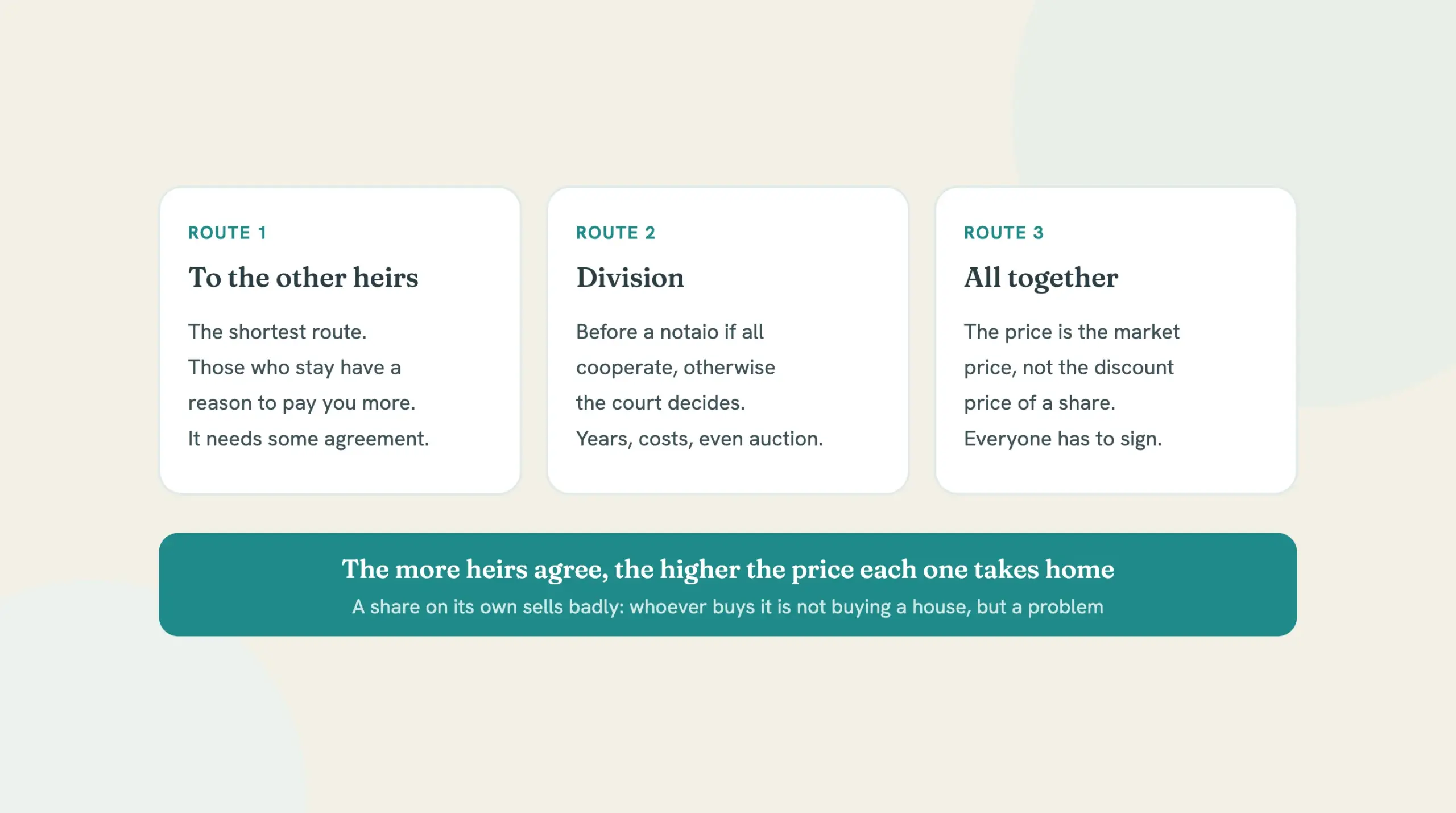
This is where the disappointment usually lands. If the house is worth two hundred thousand euros and you own a third, your share is unlikely to sell for sixty-six thousand. It usually goes for appreciably less, and the reason is simple: whoever buys it is not buying a house, they are buying a problem.
Put yourself in the buyer’s position. They become a co-owner alongside people they have never met. They can use the house only to the extent that it does not stop the others from using it, and to have it to themselves they need an agreement or have to pay the others compensation. They cannot rent out or sell the house on their own, and they cannot decide on a renovation. To get out of the joint ownership they have to resell the share or ask for a division, and if the others do not cooperate that ends up in court. All of it is paid for in a discount on the price.
When someone does buy shares, it is generally a specialist buyer who handles complicated situations and prices in the risk and the time they are taking on. This is not a market with many buyers competing, and where there is no competition the buyer sets the price.
The three ways out of joint ownership
Sell your share to the other heirs. This is the shortest route and almost always the best paid. The ones staying have a reason to pay you more than an outsider would: getting you out gives them full control of the house. The right of first refusal does not apply, because you are already selling to them. This route still goes through a deed before a notaio. Worth knowing if you are used to common law: an Italian notaio is not a notary public who witnesses signatures. They are a public official who checks that the deed is lawful and registers it, so they verify the shares, the documents and any restrictions on the property before the price is written down. If there is any dialogue left in the family, this is where to start.
Ask for a division. If there is no agreement on price, as a rule any co-owner can ask for the joint ownership to end. There are cases where a division is temporarily blocked: a provision in the will, matters still unsettled between the heirs, or a judge postponing it for up to five years where dividing straight away would seriously harm the estate. That is the first thing to check with a professional.
A division can be done before a notaio if everyone cooperates. If they do not, it goes to court, and an attempt at mediation is compulsory before proceedings start. The judge divides the property when it can be conveniently divided; when it cannot, the law provides that it be assigned preferably in full to one of the co-heirs, usually the one with the largest share, or to several co-heirs who ask for it together, with the obligation to compensate the others in cash. Only if nobody is willing to take it on those terms does it go to auction, with the proceeds divided. Either way it is a road that usually takes years and legal costs, and an auction rarely reaches the prices of a normal sale.
All the heirs sell the whole property together. This is generally the route that leaves each heir with the most, and the only one where you are selling a house rather than a legal position. The price is the market price, not the discounted price of a share. The drawback is that it needs the thing that is often missing: everyone signing.
It is worth doing the arithmetic before choosing. A third of a house sold well, split three ways, comes to more than a share sold off cheaply to a specialist buyer. Even when selling together takes a few more months and a few awkward phone calls.
What to sort out before you decide
Whether accepting the inheritance is in your interest, before you sell. Selling or transferring your share counts as accepting the inheritance: after that you can no longer renounce it, and you are liable for the deceased’s debts in proportion to your share.
Here is the consequence that weighs more than anything else in this article, and that almost nobody knows about. Accepting this way loses you the option of accepting with the benefit of inventory (beneficio d’inventario), the mechanism that caps your liability for the debts at the value of what you inherit. Without it, the deceased’s debts can be enforced against your own assets too. If you do not know for certain what debts there are, that is the reason not to sign anything before checking with an Italian notaio or lawyer.
And if you have already accepted with the benefit of inventory, selling an inherited asset requires a judge’s authorisation: without it, the benefit lapses. This is not a rare situation, because accepting with the benefit of inventory is compulsory where minors or people lacking legal capacity are among the heirs.
Getting the succession in order. In practice none of the three routes really starts before the succession has been declared and a notaio has put the chain of title straight in the land registers. This is the step that stretches the timeline more than any other, and it belongs with a notaio.
Knowing exactly what your share is. It depends on the will, if there is one, or on the shares set by law. People do discover they hold a different fraction from the one they assumed, and they discover it with negotiations already under way.
Having the whole house valued, not your part. That is the figure everything is negotiated against in all three routes: what the other heirs offer you, what a division is worth, what the house fetches sold together. Without that figure you negotiate by guesswork, and guesswork gets paid less.
Checking whether anyone else holds rights over the house. If there is a surviving spouse, or a civil union partner, and the house was the family residence and owned by the deceased or by the spouses, they are entitled by law to a right of habitation and to the use of the furniture, on top of their share. The value of those rights is taken out of the estate before the shares are worked out, so it reduces what the others receive.
It does not apply to every family situation: a spouse who is separated, but not held responsible for the separation by the court, keeps the right; a divorced spouse has no succession rights; and an unmarried partner does not inherit but may have the right to go on living in the house for a limited period, on the conditions the law provides.
There is a practical consequence worth knowing before you negotiate, and it affects us too: a right of habitation follows the house. It means the property cannot be sold free of it without the consent of whoever holds that right, and that weighs on both the price and how easily it sells.
Finally, if a minor, a person under guardianship or under amministrazione di sostegno, a court-appointed arrangement supporting an adult with reduced capacity, is among the heirs, authorisations from the guardianship judge are needed, and they are needed for a division as well, not only for a sale. That competence comes from the justice reform in force since 2023. These are things that change the value and the timeline, and they have to be cleared up before negotiating, not during.
Where we come in
We wrote it at the start and we will repeat it here, because it is the thing that matters: we buy the whole property and we do not buy individual shares. That is not a passing commercial choice, it is how our work functions: we pay the price of a house because we are buying a house.
Which means that if the heirs do agree to sell everything, we are one of the routes available. The valuation is free, the visit is free, and if the property meets our purchase criteria a written offer arrives within 48 hours of that visit. We buy in the condition the house is in, including houses that need work, and clearing it out is at our expense. There are no commissions to pay, because we do not act as intermediaries: we are the buyer.
We are an Italian company and we buy in Italy: we operate in Milan and in the provinces of Monza and Brianza, Como, Varese, Pavia and Lodi. A house outside that area is outside what we can do, and we would rather you knew it before the phone call than after.
If the heirs do not agree, the most useful thing we can tell you is what you have read above: start by talking to the other heirs, have the whole house valued, and get a professional alongside you before you sign anything.
The full picture of the steps involved in selling an inherited house in Italy, from the succession to the deed of sale, is in this guide.